For years, the “brain” of your AI was thousands of miles away in a freezing data center.
Every time you asked a question, your data traveled across the globe, processed on a massive cluster of GPUs, and flew back to your screen.
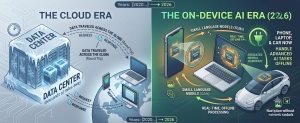
In 2026, that round trip is becoming a relic of the past. We have entered the era of On-Device AI. Thanks to the rise of highly efficient Small Language Models (SLMs) and dedicated neural hardware, your phone, laptop, and even your car are now smart enough to handle advanced AI tasks entirely offline.
On-Device AI Is Finally Mainstream
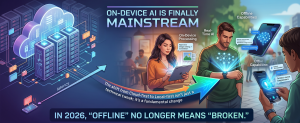
The shift from Cloud-first to Local-first isn’t just a technical tweak; it’s a fundamental change in how we interact with technology. In 2026, “Offline” no longer means “Broken.”
What’s Happening: The Rise of the SLM
The secret sauce is the Small Language Model (SLM). Models like Phi-4-mini, Gemma 3, and Qwen 3 are proving that data quality beats raw scale. These models are tiny enough to fit on a smartphone but powerful enough to outperform the massive giants of 2024 in logic, math, and coding.
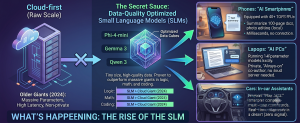
- Phones: Modern “AI Smartphones” now come equipped with NPUs (Neural Processing Units) that hit over 40 TOPS (Trillions of Operations Per Second). This allows tools like Gemini Nano or Apple Intelligence to summarize 100-page documents or edit photos in milliseconds without an internet connection.
- Laptops: “AI PCs” are the new standard. Your laptop can now run a local instance of a 14B parameter model, providing a private, “always-on” co-author for your documents that never sees a cloud server.
- Cars: In-car voice assistants have moved beyond “Play Jazz.” Integrated SLMs allow cars to interpret complex, multi-step commands and diagnose mechanical issues in real-time, even when driving through a remote desert with zero bars of signal.
Why Local AI is Winning (The 3 P’s)
- Privacy by Default
In the cloud era, every prompt was a potential privacy leak. In 2026, your most sensitive data—medical records, legal drafts, or family photos—never leaves your device. Local AI acts as a “Black Box” that only you can access. If the data never leaves the hardware, it can’t be intercepted or used to train a third-party model.

- Performance (Zero Latency)
The “thinking…” bubble is gone. Cloud AI is fast, but it still battles the laws of physics (speed of light over fiber optics). Local AI has zero network latency. Whether you’re using live transcription or real-time translation, the response is instantaneous because the processing is happening inches away from the microphone.

- Predictability & Cost
API fees and “pay-per-token” models can lead to “bill shock” for power users and small businesses. On-device AI is free after the initial purchase. You can run ten million inferences on your laptop and your bill remains exactly $0.

The Future is Hybrid
Does this mean the cloud is dead? Not quite. We are moving toward a Hybrid AI model:

- Local First: Your device handles 90% of daily tasks (emails, photo editing, basic coding, scheduling).
- Cloud Escalation: For massive, “world-scale” reasoning—like simulating a new drug molecule or analyzing a decade of global financial data—your device securely hands off the task to a frontier model in the cloud.
Bottom Line
By the end of 2026, “Is this AI?” will be a moot question. Intelligence will be as baked-in and invisible as the electricity in your walls.
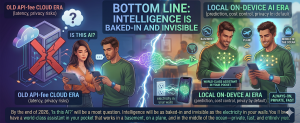
You’ll have a world-class assistant in your pocket that works in a basement, on a plane, and in the middle of the ocean—private, fast, and entirely yours.