AI Development Cost by Region in 2025
Why AI Development Costs Matter in 2025
The artificial intelligence market is no longer a frontier; it’s the foundation of modern innovation. By 2025, AI is expected to contribute over $15 trillion to the global economy, embedding itself into everything from customer service to complex scientific research. For businesses, the question has shifted from “Should we invest in AI?” to “How can we invest in AI wisely?”

Understanding AI development costs is no longer a technical concern—it’s a strategic imperative. A clear grasp of the financial landscape prevents budget overruns, ensures resource allocation aligns with business goals, and ultimately determines the return on investment for your AI initiatives. This guide breaks down the cost components, compares different approaches, and provides a realistic financial roadmap for 2025 and beyond.
Key Factors That Influence AI Development Cost
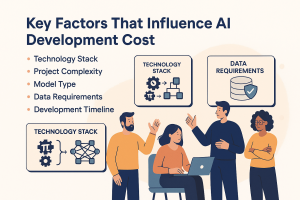
The cost of an AI project is not a one-size-fits-all figure. It’s a variable equation shaped by several core factors:
- Technology Stack: Are you using open-source frameworks (like TensorFlow, PyTorch) or premium, enterprise-grade platforms? The choice impacts licensing fees and development speed.
- Project Complexity: A simple rule-based chatbot costs a fraction of a sophisticated, self-learning predictive maintenance system for manufacturing. Complexity is the primary cost driver.
- Model Type: Standard models are cheaper. Developing a custom, state-of-the-art large language model (LLM) or a complex generative AI system requires massive computational power and expert talent, skyrocketing costs.
- Data Requirements: Is your data clean, labeled, and readily available? Or does it require extensive (and expensive) collection, cleaning, and annotation? Data is the fuel, and its quality directly impacts cost.
- Development Timeline: A rushed project often costs more due to the need for a larger team and premium computing resources. A phased, agile approach is generally more cost-effective.
AI Project Cost Breakdown: From Idea to Deployment
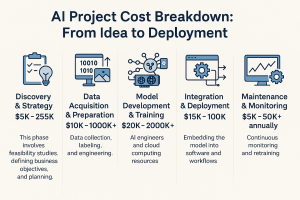
To demystify the budget, let’s follow the AI development lifecycle:
- Discovery & Strategy ($5K – $25K): This phase involves feasibility studies, defining business objectives, and planning. Skipping this is a recipe for cost overruns.
- Data Acquisition & Preparation ($10K – $100K+): This is often the most underestimated cost. Data collection, labeling (which can cost $0.10 to $5.00 per image or text sample), and engineering can consume up to 80% of the project time and budget.
- Model Development & Training ($20K – $200K+): This includes the cost of AI engineers and the significant cloud computing (GPU) resources needed for training. Complex models can require thousands of hours of GPU time.
- Integration & Deployment ($15K – $100K): Embedding the AI model into your existing software, hardware, and business workflows requires skilled backend developers and can be technically challenging.
- Maintenance & Monitoring ($5K – $50K+ annually): AI models can “drift” as data patterns change. Continuous monitoring, retraining, and updating are non-negotiable ongoing costs.
Cost Comparison by AI Type
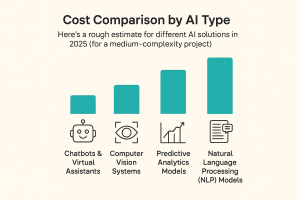
Here’s a rough estimate for different AI solutions in 2025 (for a medium-complexity project):
- Chatbots & Virtual Assistants: $40,000 – $150,000. Cost rises with the level of natural language understanding (NLU) and integration with backend systems.
- Computer Vision Systems: $50,000 – $250,000+. Used for quality control, facial recognition, or medical imaging. Cost is highly dependent on image resolution and annotation complexity.
- Predictive Analytics Models: $60,000 – $200,000. Leverages historical data to forecast trends, crucial for finance and logistics.
- Natural Language Processing (NLP) Models: $75,000 – $300,000+. Powers sentiment analysis, advanced content generation, and sophisticated translation services. Custom LLM fine-tuning falls on the higher end.
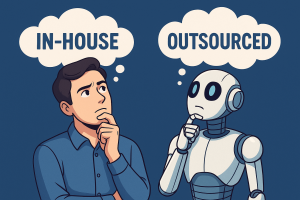
In-House vs Outsourced AI Development: Which Is Cheaper?
- In-House Team:
- Pros: Full control, deep alignment with company culture, intellectual property protection.
- Cons: Extremely high cost to hire and retain top AI talent (salaries can exceed $200,000 for a senior ML engineer), plus benefits, software, and hardware overhead.
- Best for: Large enterprises with a long-term, recurring need for AI development.
- Outsourced AI Agency:
- Pros: Access to a diverse team of experts, faster time-to-market, predictable project-based pricing, and lower initial investment.
- Cons: Less direct control, potential communication challenges, and reliance on a third party.
- Best for: Most SMEs and companies looking to build a specific, well-defined MVP or project.
In 2025, for most single projects, outsourcing to a specialized region (see below) often provides the best balance of cost and quality.
Hidden Costs You Shouldn’t Overlook
Many projects fail due to unanticipated expenses:
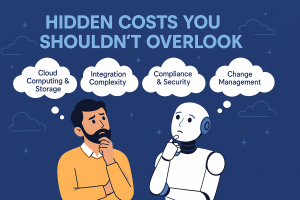
- Cloud Computing & Storage: Training and running models incur ongoing fees from providers like AWS, Google Cloud, or Azure. These can easily run thousands of dollars per month.
- Integration Complexity: Connecting the AI to legacy systems can be more time-consuming and expensive than building the AI itself.
- Compliance & Security: Ensuring your AI model complies with regulations like GDPR or industry-specific standards requires legal and technical expertise.
- Change Management: Training your workforce to use and trust the new AI system is a critical but often forgotten cost.
AI Development Cost by Region (2025 Overview)
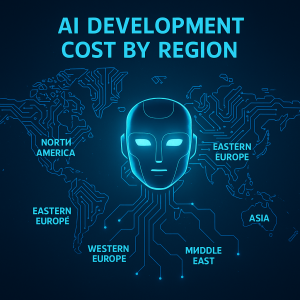
- North America: ($150 – $250+/hour) The most expensive region, but home to leading experts and cutting-edge innovation. Ideal for highly complex, research-oriented projects.
- Western Europe: ($100 – $180/hour) Similar high quality and cost to North America, with strong data protection laws.
- Eastern Europe: ($50 – $100/hour) Offers an excellent balance of high-quality talent and competitive rates, particularly strong in engineering.
- Asia (India, Vietnam): ($25 – $60/hour) The most cost-effective option, but requires careful vendor vetting to ensure quality and communication standards.
- Middle East (UAE): ($80 – $150/hour) A growing hub with significant government investment, positioning itself as a high-quality AI center.
How to Optimize Your AI Development Budget
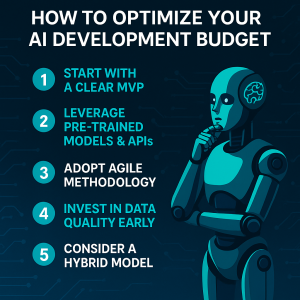
- Start with a Clear MVP: Focus on a minimal viable product that solves one core problem. Avoid feature creep.
- Leverage Pre-Trained Models & APIs: Use services like OpenAI, Google Vision AI, or AWS Rekognition to avoid building common capabilities from scratch.
- Adopt Agile Methodology: Build in sprints, test frequently, and adapt based on feedback. This prevents costly mistakes late in the process.
- Invest in Data Quality Early: “Garbage in, garbage out.” Spending on proper data preparation upfront saves massive rework costs later.
- Consider a Hybrid Model: Build a small, strategic in-house team to manage direction and outsource specific development tasks.
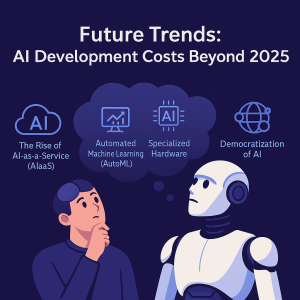
Future Trends: AI Development Costs Beyond 2025
- The Rise of AI-as-a-Service (AIaaS): Platforms will offer more sophisticated plug-and-play AI tools, reducing the need for custom development for common tasks.
- Automated Machine Learning (AutoML): Tools that automate parts of the model-building process will become more powerful, lowering the barrier to entry and reducing development time and cost.
- Specialized Hardware: The development of more efficient AI-specific chips will continue to drive down cloud computing costs.
- Democratization of AI: While complex AI will remain expensive, the cost of entry-level AI applications will plummet, making it accessible to virtually every business.
Conclusion: Investing Wisely in AI for Long-Term ROI
Navigating AI development costs in 2025 requires a blend of technical understanding and strategic business acumen. The goal is not to find the cheapest option, but the most intelligent investment. A well-planned, strategically executed AI project, even with a higher initial price tag, delivers exponential value through increased efficiency, new revenue streams, and a powerful competitive advantage.

By understanding the cost factors, choosing the right development partner, and planning for the long term, your business can unlock the true potential of AI and build a smarter, more profitable future.